Applied R&D with a global Tier-1 automotive manufacturer · 2022–2026
Physical AI for Design & Material
CAD goes in, a graph neural network learns the part’s physics, and the shape itself becomes something an optimiser can search — in minutes.
The industrial problem
In manufacturing, part geometry, material behaviour and process settings are three faces of one physical problem — but in practice they are owned by three different teams, three different toolchains and three different trial loops. Answering "will this part come out within tolerance, and how should we make it?" traditionally means months of physical prototyping: mould it, scan it, measure the deviation, adjust, repeat.
The hard constraint is data scarcity. Every industrial datapoint is a physical trial that consumes machine time, material and engineering hours, so an AI system here cannot assume big data — it has to learn the physics of a part from a handful of very expensive experiments and still be trustworthy enough that an engineer will sign off on the result. That is the opposite of the regime most machine learning is taught in.
The system
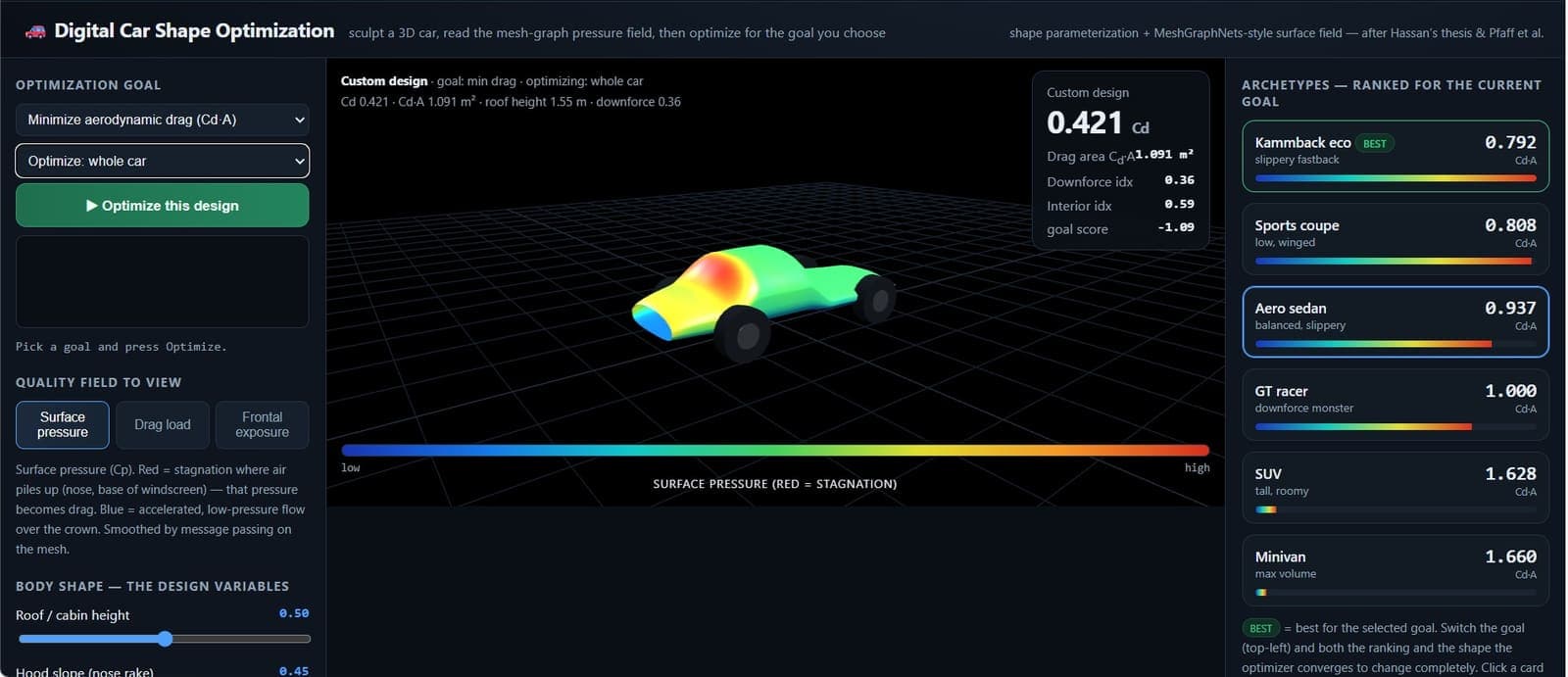
Digital car shape optimisation. Body geometry is a set of continuous design variables; the mesh-graph network predicts the pressure field, and archetypes are re-ranked live against whichever goal is selected — minimum drag, maximum downforce, maximum interior volume.
Scroll the figure sideways →
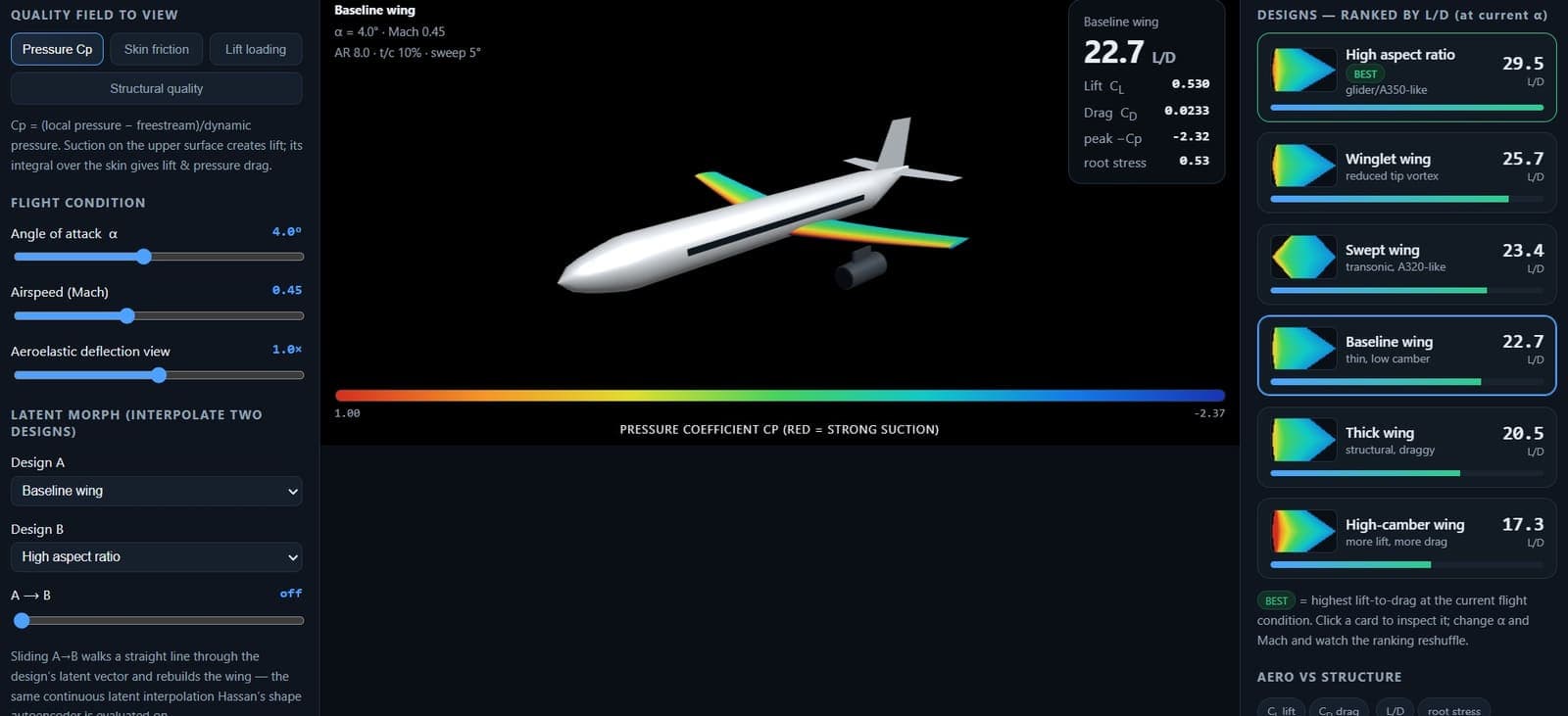
Aircraft quality explorer. The same pipeline on a swept wing: flight condition on the left, predicted pressure coefficient on the model, and a latent-space morph that walks continuously between two designs — the shape autoencoder from the parametrisation thesis, made interactive.
Scroll the figure sideways →
In motion
The same pipeline running on a car body and on a swept wing.
How it was built
- 01
The part becomes a graph
The mesh is the model. Nodes carry coordinates, zone values and surface area; process parameters — mould temperature, cooling time, press force, charge weight — condition the whole graph. An Encode–Process–Decode graph network then predicts a per-node quality field (warpage in millimetres, pressure, stress) directly on the geometry, at any mesh resolution.
- 02
The design space becomes continuous
A point-cloud autoencoder and a DeepSDF-style implicit decoder learn a latent space of shapes, so "the design" stops being a fixed CAD file and becomes a vector you can interpolate, morph and search — walk a straight line from one wing to another and the geometry rebuilds continuously along the way.
- 03
Search the shape, not the file
With a fast surrogate standing in for the solver, the optimiser moves through that latent space against the engineer’s actual objective — minimise drag, maximise lift-to-drag, maximise interior volume — and returns ranked designs with the trade-off curve that produced them. A car body and a swept wing run through the identical pipeline; only the objective changes.
What it measured
- ~6 months → ~5 min
- Manual development loop compressed into an automated workflow
- ~$300k → ~$50
- Cost of running that loop, per project
Achieved in applied work at a global Tier-1 automotive manufacturer, where the founder established and led the AI team for global OEM projects.
What this builds on
- Pfaff, Fortunato, Sanchez-Gonzalez & Battaglia, ICLR 2021
- Learning Mesh-Based Simulation with Graph Networks — implemented from scratch in PyTorch, including world edges, training noise and autoregressive rollout, and used as the simulation core.
- M.Sc. thesis, Bonn-Aachen International Center for Information Technology (b-it), 2025
- Deep Learning-Based 3D Shape Parametrization in Manufacturing — industry-side supervision by the founder; supplies the continuous design space the optimiser searches.
Archive: fable5_design_material_process (fable5_platform, fable5_deepmind, fable5_hassan_thesis)