COHORT 1 · JAIPUR · 25 SEATS
AI is eating entry-level jobs. Become the engineer who builds it instead.
A selective industrial AI apprenticeship in Jaipur. 4 months. Real manufacturing problems. A portfolio no certificate can compete with.
You've done everything they told you to.
- 01
Bought the course — 92% never finish.[1]
- 02
Collected the certificate — recruiters stopped reading them years ago.
- 03
Learned the skill, never the knowledge under it — so it expires, and you buy the next course.
- 04
Your college optimised for placement day. Nobody optimised for the ten years after it.
- 05
Your GitHub — how many of those projects could you actually demo, line by line, today?
[1] MOOC completion research, Class Central — typical completion rates below 10%.
Skill is rented. Knowledge is owned.
Indian engineers run the machines inside some of the best companies in the world. The intellectual property those machines produce belongs to someone else. There is a reason for that, and it is not talent: the knowledge sits with whoever owns the problem, and it is passed down inside those organisations generation after generation. The skill sits with whoever executes — and skill has to be re-earned every few years, so the next generation starts again from zero.
That is the trade this country keeps making, in engineering and in everything else: we supply the execution, someone else keeps the understanding, and the value accrues where the understanding is. An apprenticeship that teaches you only the skill is not helping you escape that trade. It is selling you a ticket into it.
Knowledge
Why the thing exists, and what it is for
Physics, the problem, the customer, the economics, the decision that has to be made. It compounds. It transfers to your children. It does not expire when a framework does.
Skill
How to operate the tool of the moment
The library, the framework, the certification. It has a shelf life measured in months, and the moment it expires you start again from zero — unless there is knowledge underneath holding it up.
AI is an amplifier. It makes a good decision very good, and a bad decision much worse — much faster.
Which is why this lab does not stop at prediction. Prediction, then the decision it supports, then the action it triggers: you are trained on all three, because the engineers who only own the first one are the easiest to replace.
You don't take our course. You join our lab.
From day one you work on a live industrial problem — the way M.Sc. students work in German research institutes. Skills are absorbed by shipping, not by watching.
Real industrial problem statements
Manufacturing, materials, finance, spatial — the kind a company pays to solve, not a tutorial dataset.
Direct mentorship
DLR / Fraunhofer methodology, engineer to engineer, from someone who shipped this in production.
Production code reviews
Not quizzes. Your code is read the way it would be read on a real team.
Real job titles, as experience
Product manager, data engineer, data scientist, MLOps, full-stack AI — the roles a project actually needs, done by you.
How the industry is actually built
How an organisation works, where the money and the decisions sit, and where you would fit in it.
Interview war-room
Mock technical deep-dives on YOUR system, until you can defend every line of it.
Paid internships & introductions
We use our industrial connections to recommend you, and pay for internships where we can.
Cohort of 25, screened-in
A small lab, not a lecture hall. Any age, any branch, any profession.
A community that outlasts the cohort
Come to the centre, work next to each other, stay in the group for life. Bullying is the one thing that gets you removed.
The syllabus is the project.
Eight tracks, each one an actual system that exists in the lab. You do not study a subject and then look for somewhere to apply it — you take a problem, and the skills arrive as by-products of shipping it. Every track below links to the real project it is drawn from.
The problem
Monitor a live production process from video and sensor data, and flag deviations in real time — on a camera installed yesterday, with no labelled dataset to train on.
What you ship
A deployed monitoring service with a live dashboard, running on real footage.
Skills absorbed
The problem
Take a CAD file, mesh it into a graph, and predict how press settings — temperature, cooling time, force, charge placement — turn into a quality field across the whole part. Then search that process window instead of trialling it.
What you ship
A process-conditioned graph model with a Bayesian search over the settings, and the convergence record that justifies its recommendation.
Skills absorbed
The problem
Predict material and part behaviour from sparse industrial datasets where every datapoint costs a physical trial — then make the geometry itself something an optimiser can search.
What you ship
A validated prediction model behind an engineer-facing interface, with a searchable design space.
Skills absorbed
The problem
A finite-element run that takes forty-five minutes is useless inside an optimisation loop that wants thousands of evaluations. Learn the solver, then prove where the learned version still disagrees with it.
What you ship
A surrogate model benchmarked frame by frame against the solver, with its error distribution published rather than cropped out.
Skills absorbed
The problem
Of all the settings or shapes you could choose, which do you actually run — when the search space is vastly larger than the budget for exploring it? Bayesian search when trials are expensive, population search when the landscape is ugly.
What you ship
Two working optimisers on one problem, with the trade-off curve and the full trial history behind the answer.
Skills absorbed
The problem
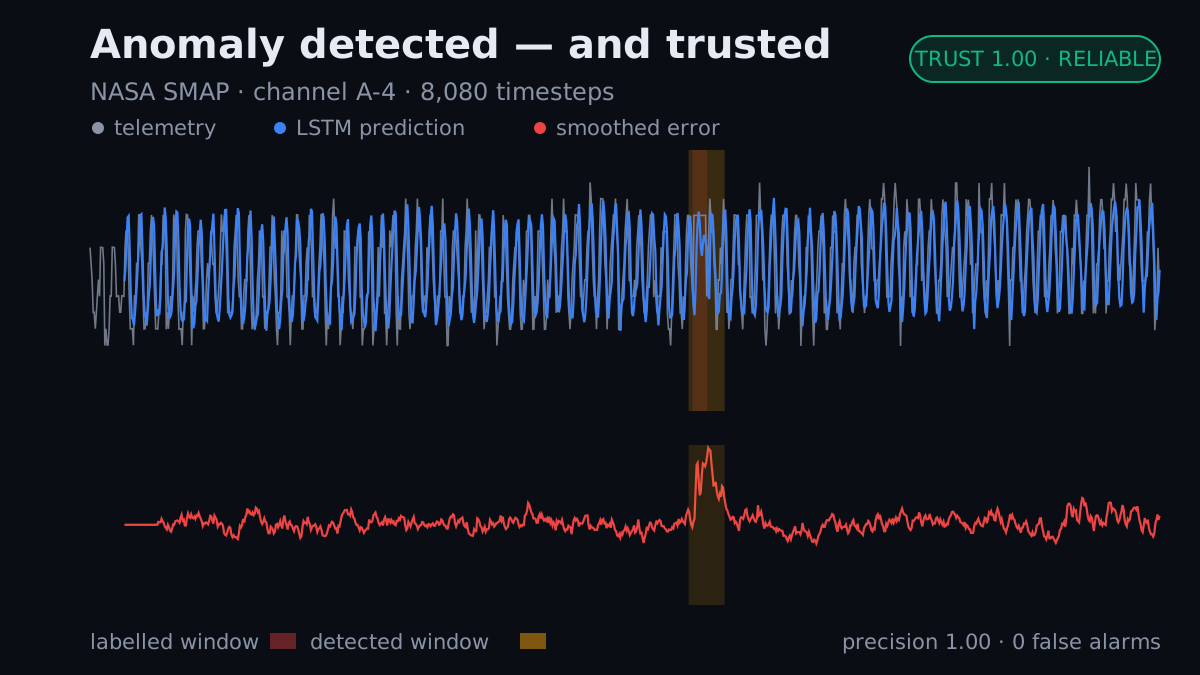
Catch the earliest signs of failure in thousands of streaming sensor channels — and refuse to raise the alarm when the evidence the model leaned on was itself already contaminated.
What you ship
A detector with explainable alarms and a trust score that marks its own unreliable detections as unreliable.
Skills absorbed
The problem
Model live market time-series and separate signal from noise under backtesting discipline strict enough that the system cannot manufacture its own track record.
What you ship
A research dashboard with point-in-time-honest backtests, a prediction journal, and an automatic grader scoring its own past calls.
Skills absorbed
The problem
Score and rank real locations from layered geospatial data — access, land use, infrastructure trajectory, risk — into a verdict a decision-maker can take apart a year later.
What you ship
An interactive spatial analysis engine with a map interface and an auditable score behind every verdict.
Skills absorbed
Training a model is one box out of four.
A real industrial project, the way it actually ran: a supplier whose product line was being deleted by the shift to electric vehicles, and who needed a new part developed faster, cheaper and to a quality standard they had already contractually promised. Every course you have seen teaches phase three. The interviews you want are decided by phases one, two and four.
- 01
Understand the need nobody can articulate
The customer cannot tell you the solution. They can only communicate the pain — here, that a fuel-tank product line is being obsoleted by electrification, and the new product has to clear quality criteria that were signed at the quotation stage, faster and with a fraction of the team. Your first job is to translate that into a problem statement an engineer can attack.
Stakeholder interviews · Problem framing · Domain reading
- 02
Sketch the solution — and argue for it
Before a line of code: what could be built with data, AI, research and engineering, and does it make sense practically and financially? You talk to every stakeholder, size the AI capability honestly, run the risk assessment, and decide whether to do it at all. Then you write the proposal that gets the experiment approved and the team hired.
Solution architecture · Feasibility & risk · Proposal writing · Negotiation
- 03
Get the data — as little of it as possible
What data, why that data, how to obtain it, and which sampling strategy gets you there with the fewest physical trials — because in industry every datapoint costs machine time and material. Then the unglamorous half: data engineering, pipelines, the solution architecture that has to survive contact with an IT department, and the security and risk review.
Data engineering · Design of experiments · Sampling strategy · Security review
- 04
Validate it, launch it, and know when to retire it
Validate the data product against reality, not against a test split. Show each stakeholder what they specifically get out of it. Decide how to launch, to whom, and what adoption actually requires — user flow, communication, priority management. And document it well enough that it outlives you, including the decision to switch it off when it stops earning its place.
Validation · Product management · Adoption & UX · Documentation
Running through all four, continuously: communication, research, iteration, and the judgement call about what to launch, to whom, and when to stop.
Judge the lab by its output, not its ads.



Learn from someone who has actually built it.
M.Sc. Autonomous Systems, Bonn-Aachen International Center for Information Technology (b-it) · anomaly detection & Explainable AI for satellite operations at DLR · weightless neural networks on GPU at Fraunhofer FKIE · established and led the AI team for global OEM projects at a Tier-1 automotive manufacturer.
Meet the founder25 seats. A screening task. Not everyone gets in.
We'd rather run a small lab of committed engineers than a large hall of certificate collectors. The screening takes 30 minutes and tells you more about yourself than any counselor call.
- 01
Apply
2 minutes
- 02
Screening task
30 minutes
- 03
Interview call
Technical conversation, no sales script
- 04
Cohort offer
One of 25 seats
Fee & scholarship details discussed at the offer call — we don't do counselor-style pressure sales.
What we commit to, in return
- The first month is free. Work on the real problem, then decide whether to continue.
- No advertising at you, no counselor calls, no manufactured urgency.
- Fee is never the reason you are turned away — not if you are from a BPL household, in genuine financial difficulty, or can argue why this knowledge should reach you.
- The community stays open and free whether or not you ever enrol.
- What you pay goes back into equipment, paid internships and, where we can, employment inside this community.
- Bullying is the one thing that gets someone removed. There is no second conversation about it.
Straight answers
No. There is no syllabus of videos to watch. You join a lab, get assigned to a live industrial problem, and absorb skills by shipping — with production code reviews instead of quizzes.
Yes — industrial AI lives exactly where domain engineering meets code. The screening task measures aptitude and commitment, not your branch. Several of our problem tracks (manufacturing, materials, spatial) reward core-branch intuition.
No, and no. Any age, any branch, any profession — school students, undergraduates, postgraduates, PhD candidates and working engineers are all welcome to apply. What is assessed is whether you will do the work, not what stage you are at.
Fee and scholarship details are discussed at the offer call — we don't do counselor-style pressure sales. The principle is fixed, though: if you are from a BPL household or in genuine financial difficulty, or if your motivation letter makes the case for why this knowledge should reach you, the fee is not what decides whether you get in.
You shouldn't, on our word. That is exactly why the first month is free: come in, work on the real problem, meet the mentor, and then decide whether to continue. We will not run ads at you, we will not chase you with a counselor, and everything the lab has built is published in the showcase for you to judge before you apply.
Yes. The community is open and free: come to the centre, work alongside other people, talk to them, and talk to me when I am there. You do not have to pay to be in the room. The one rule is that bullying gets you removed, permanently.
Honest answer: we don't promise placements and we won't show you invented percentages. What you get is a deployed portfolio project, a reference letter, interview war-room practice on your own system, and our industrial connections used to recommend you for internships — paid, where we can fund them. That is what wins interviews. The rest is yours.
The apprenticeship runs 4 months alongside your college schedule. The deadlines are real because the problems are real — plan for consistent, serious build time every week. The exact cadence is discussed at the interview call.
Because 25 seats means we select for commitment, not collect enrollments. The 30-minute task tells you more about yourself than any counselor call — and it's the first taste of how the lab actually works.